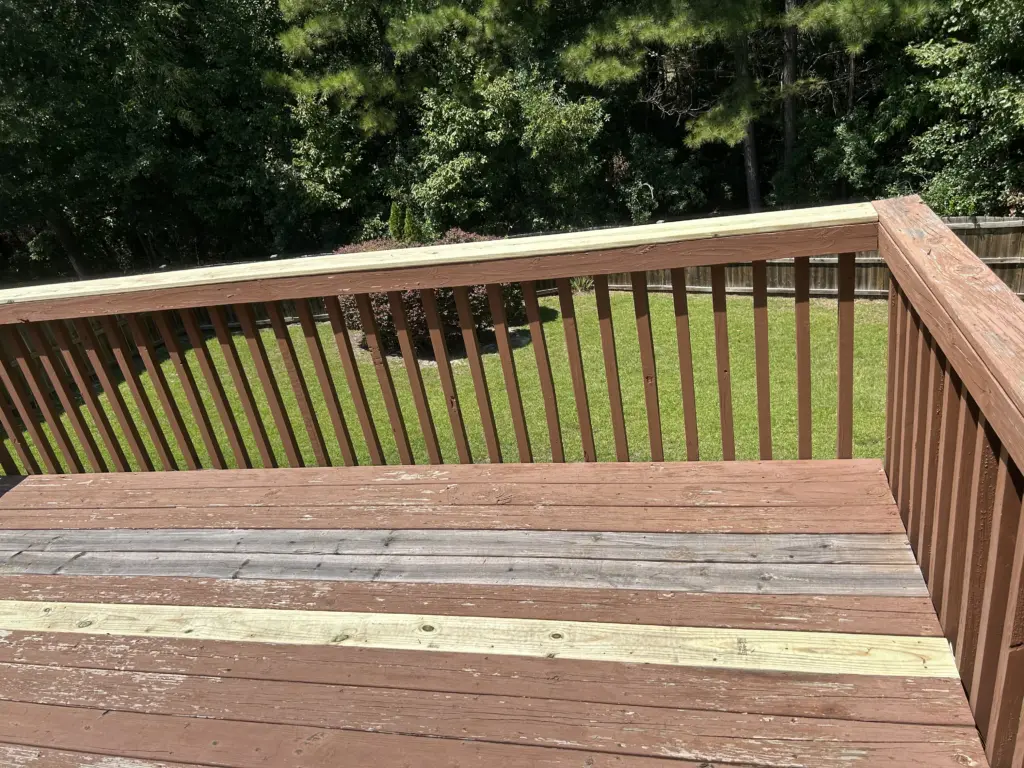
Few things beat a Midlands evening on the back deck — until the Carolina sun and summer humidity start working on the wood underneath you. Between long stretches of 90-degree days, pop-up afternoon thunderstorms, heavy spring pollen, and the shade of all those Columbia oaks and pines, an unprotected deck ages faster here than most homeowners expect. The good news: a little know-how and a steady maintenance rhythm keep your boards solid, safe, and good-looking for years.
First, Know What Your Deck Is Made Of
This guide is written for real wood decks — pressure-treated pine, cedar, and similar softwoods, which make up the vast majority of decks across the Midlands. If you have composite or PVC boards, the rules are different: those aren't stained or sealed, and care is mostly regular washing. Not sure what you have? Bare wood shows real grain and splinters where it's worn; composite feels more uniform and usually has a molded grain pattern that repeats. The rest of this article assumes wood.
Why South Carolina's Climate Is So Hard on Decks
Wood never stops reacting to the weather around it, and few climates ask more of it than ours. Columbia routinely sees weeks of intense heat, high humidity, and quick downpours followed by blazing sun. That mix drives three distinct problems:
- Graying: Ultraviolet light breaks down lignin, the natural compound that gives wood its color and helps bind its fibers. Left bare, even pressure-treated pine fades to a dull silver-gray within a season or two.
- Warping and cupping: Boards swell as they soak up moisture, then shrink as they bake dry. Repeated across a humid Midlands summer, that constant movement leads to cupped, split, and springy boards — and popped fasteners.
- Rot and mildew: Shade, pollen, and trapped moisture create ideal conditions for mold, mildew, and wood-decay fungi. North-facing sections, spots under trees, and anywhere water pools are usually the first to go soft.
Staining and sealing slow all three by shielding the wood from UV and controlling how much water it takes on. Think of it less as a one-time project and more as ongoing protection against a climate that never really lets up.
The Clean, Repair, Stain, Seal Cycle
A deck that lasts follows a simple four-step cycle. Skipping steps — especially cleaning and repairs — is the most common reason a fresh finish fails early.
1. Clean
Start by clearing leaves and debris from the surface and out of the gaps between boards, then wash with a cleaner made for decks to lift mildew, pollen, and the gray, weathered top layer. A garden pump sprayer and a stiff brush handle most decks. Look for a product with a mildewcide, or an oxygen-based (percarbonate) cleaner, rather than reaching for straight chlorine bleach — chlorine can lighten and weaken the wood fibers and corrode fasteners over time. If you use a pressure washer, keep it on a low setting, use a wide fan tip, and hold the wand a foot or more from the boards; too much pressure gouges the soft summer grain and leaves fuzzy, splinter-prone wood. Then let everything dry fully — often a couple of dry days — before you move on.
2. Repair
With the deck clean and dry, walk every square foot. Replace rotted or badly split boards, drive down or swap out popped nails and screws, and check the ledger board where the deck attaches to your house — that connection is critical for safety. Snug up loose railings and posts while you're at it. It's far cheaper to replace one board now than to stain over a problem and lose the whole section later.
3. Stain
Stain adds color and, just as importantly, the UV pigment that shields the wood from our relentless sun. Apply it only when the boards are fully dry and no rain is in the forecast for a day or two — not always easy to schedule around a Columbia summer, so keep an eye on the radar. Work in the shade or early in the morning when you can; staining in direct afternoon heat makes the finish flash-dry before it can soak in. Stir the stain rather than shaking it, and test your color on an out-of-the-way board first, since weathered pine takes color very differently than the sample on the can.
4. Seal
Many quality products — including lines from Sherwin-Williams — combine stain and sealer in one, and the sealing side is what actually repels water and keeps humidity from creeping into the grain. However you apply it, finish by working it into the wood with a good brush; a quality Purdy or similar drives the product into end grain and along board edges — where rot likes to start — far better than a roller alone. Pros often speed things up with a sprayer (Graco and similar) and then "back-brush" the finish by hand. The brushing is the step that makes it last.
Transparent vs. Semi-Transparent vs. Solid Stain
Choosing a stain is really a trade-off between showing off the wood grain and maximizing protection. Here's how the three main types compare in our climate:
- Transparent (clear) stains show the most natural grain and look beautiful on newer wood, but they carry the least UV pigment. In full Midlands sun, expect the shortest life and the most frequent reapplication.
- Semi-transparent stains are the sweet spot for many Columbia decks. They let the grain show through while adding enough pigment to fight graying, and because they penetrate rather than form a thick film, they tend to wear evenly instead of peeling.
- Solid (opaque) stains hide the grain the way paint would, but they offer the most UV and moisture protection and can breathe new life into an older, weathered deck. The trade-off: as a film-forming finish, a solid stain can peel if water works underneath it, so surface prep matters even more.
As a rough guide, horizontal surfaces that take direct sun and foot traffic — the deck floor and stair treads — wear faster than shaded railings and vertical faces, so many homeowners choose a tougher finish for the floor and something that shows more grain on the rails.
How Often to Re-Stain in the Midlands
There's no single answer, because sun exposure, tree cover, and the product you choose all matter. As general guidance for our climate — not a guarantee — semi-transparent stains on a deck floor often need refreshing every two to three years, while solid stains and shaded vertical surfaces may stretch longer. Fully exposed decks in open sun — think a west-facing deck in Blythewood, Lexington, or Chapin — will land on the shorter end, while a tree-shaded deck in Forest Acres or Irmo may go a bit longer between coats. Always check the manufacturer's directions for your specific product, too.
The simplest way to judge for yourself is the water test: sprinkle a little water on the boards. If it beads up, your seal is still working. If it soaks in and darkens the wood, it's time to plan a refresh.
Simple Maintenance That Extends the Life of Your Deck
- Sweep regularly. Leaves, pollen, and pine straw trap moisture against the boards and feed mildew. A quick sweep after storms goes a long way.
- Keep water moving. Move planters occasionally, clear the gaps between boards, and make sure nothing dams up water on the surface.
- Rinse off pollen in spring. Our heavy Midlands pollen season leaves a film that holds moisture; a gentle wash keeps it from setting in.
- Trim back nearby branches. More airflow and sun after rain means the deck dries faster and stays healthier.
- Address spills and mildew spots early, before they work down into the grain.
Signs It's Time to Re-Seal
Your deck will tell you when it needs attention. Watch for:
- Water soaking in instead of beading up
- Color fading to gray, or looking blotchy and uneven
- A rough, dry, or splintery feel underfoot
- Green or black mildew that keeps coming back
- Small surface cracks or raised grain
Catch these early and a clean-and-recoat is usually all you need. Ignore them and water works into the wood — which is when cupping, rot, and full board replacement start adding up.
Protecting a deck in Columbia's heat and humidity is absolutely doable — it just rewards the homeowners who stay a step ahead of the weather. If you'd rather skip the ladder, the cleaner, and the guesswork on stain choice, Handy-Pro Solutions is happy to help. We serve Columbia and the surrounding Midlands — from Irmo and Lexington to Blythewood and Forest Acres — and we'd be glad to take a look at your deck and put together a free, no-pressure estimate whenever you're ready.
Get a free estimate
Planning a project in Columbia or the Midlands? We’d love to help.